
If you’ve ever started creating a company profile, you’ve probably asked yourself one question before anything else: How many pages should it be?
The answer surprises many business owners because there isn’t a universal page count that works for every company. After helping businesses across industries create professional corporate profiles, we’ve found that most effective company profiles range between 4 and 12 pages. However, the ideal length depends entirely on your audience, your objectives, and how you plan to use the document.
A startup introducing itself to potential clients doesn’t need the same level of detail as a construction company bidding for a government contract. Likewise, an investor presentation differs significantly from a business profile designed for prospective customers.
The real challenge isn’t creating the longest document. It’s presenting enough information to build credibility without overwhelming busy decision makers who may only spend a few minutes reviewing your profile.
In this guide, you’ll learn:
- The ideal page count for different business situations
- How company profile length changes across industries
- When a concise profile works better than a detailed one
- Why thoughtful design often matters more than adding extra pages
- The essential sections every company profile should include, regardless of length
By the end of this guide, you’ll know exactly how many pages your company profile should have—and more importantly, why.
How many pages should a company profile be?
For most businesses, a company profile should be between 4 and 12 pages, depending on its purpose. Shorter profiles work well for introductions and networking, while detailed profiles are better suited for tenders, procurement processes, investors, and large enterprise opportunities. A 1 to 2-page profile is ideal for quick introductions, a 4 to 8-page profile works best for most B2B businesses, while companies applying for tenders, attracting investors, or managing large projects often require a comprehensive profile of 12 to 20 or more pages.
Why There Is No "Perfect" Number of Pages
One of the biggest misconceptions about a company profile is that a specific page count automatically makes it more professional.
It doesn’t.
A well-designed six-page corporate profile can outperform a cluttered twenty-page document because readers value clarity more than volume.
Research from the Nielsen Norman Group consistently shows that users scan business documents rather than read them word for word. Clear layouts, concise information, and logical content hierarchy significantly improve readability and engagement. Similarly, studies by Microsoft suggest that digital readers make rapid decisions about whether content is worth continuing, making concise communication increasingly important.
This is why professional company profiles focus on answering the reader’s questions efficiently instead of filling pages unnecessarily.
Before deciding on the length of your profile, ask yourself three questions:
- Who will read it?
- What decision do you want them to make?
- How much information do they actually need?
Once you answer these questions, choosing the right page count becomes much easier.
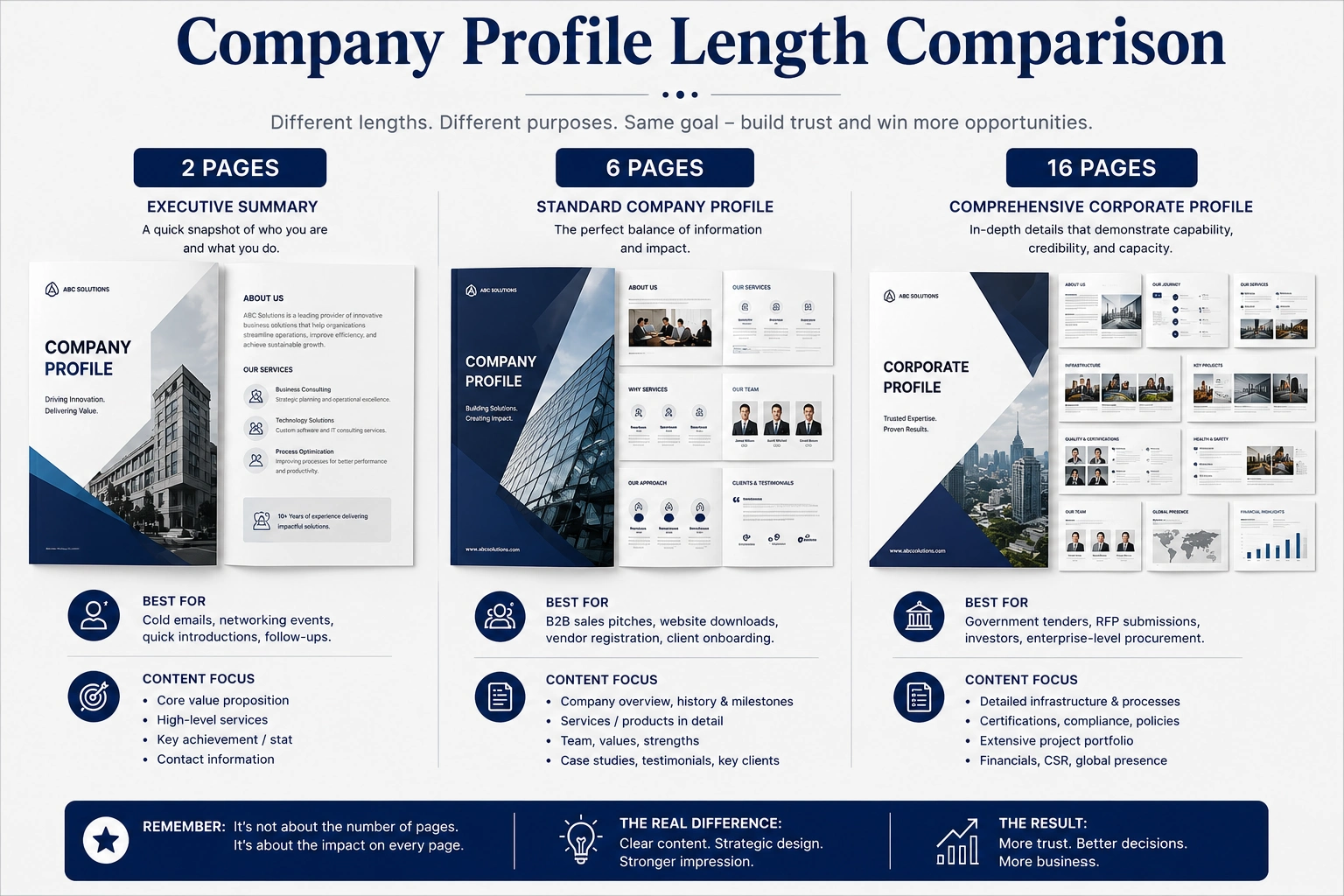
Choosing the Right Company Profile Length Based on Its Purpose
The biggest factor that determines your company profile’s length isn’t your company size—it’s how you intend to use it.
Different audiences expect different levels of information. A procurement officer evaluating multiple vendors has very different expectations from a potential customer who simply wants to understand what your business does.
Let’s look at the most common use cases.
1. The 1 to 2-Page Executive Summary
Sometimes, less really is more.
An Executive Summary is designed to introduce your company quickly. It gives readers just enough information to understand who you are and why they should continue the conversation.
Best Used For
- Cold email attachments
- Networking events
- Sales follow-ups
- Business introductions
- Meeting leave-behinds
- Initial conversations with potential partners
What to Include
- Company overview
- Unique value proposition
- Core services or products
- Key achievements
- One impressive statistic or milestone
- Major client logo or testimonial
- Contact information
The goal isn’t to tell your entire company story.
Instead, it should encourage readers to ask for more information.
Think of it as the business equivalent of a movie trailer—it creates interest without revealing everything.
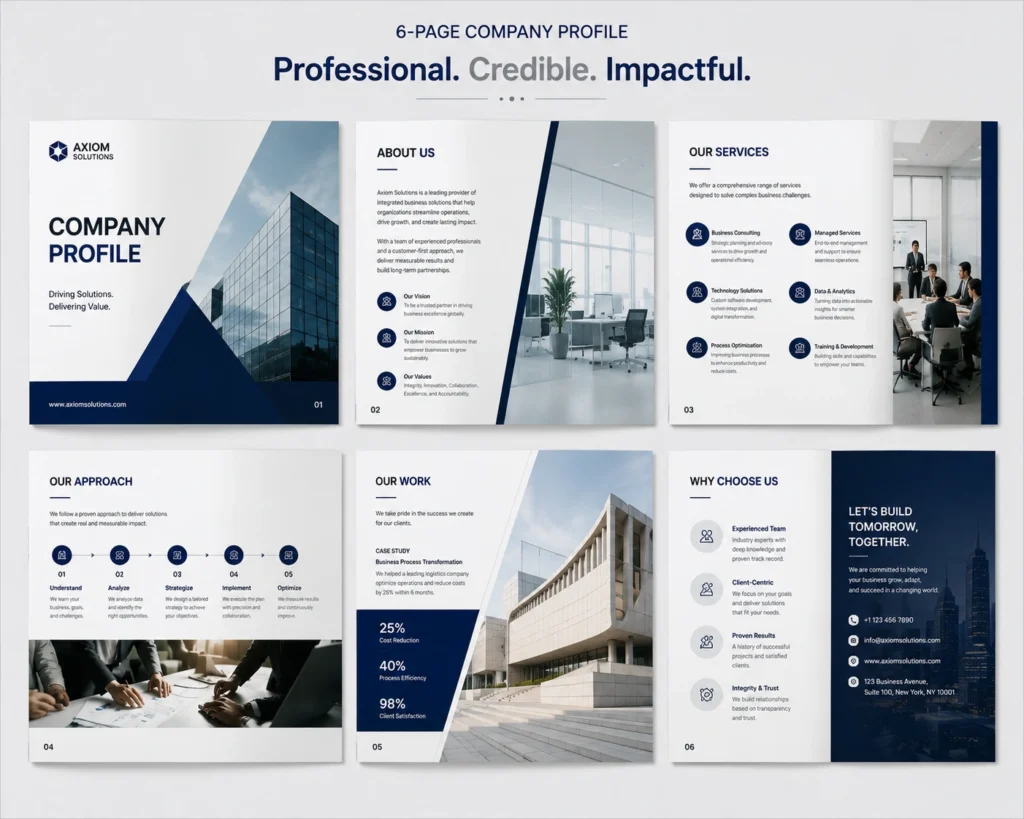
2. The 4 to 8-Page Standard Company Profile
For most businesses, this is the ideal length.
A 4 to 8-page company profile offers enough space to explain your capabilities while remaining concise enough for busy executives to read.
This format is particularly effective for companies that regularly work with B2B clients, distributors, channel partners, and corporate buyers.
Best Used For
- Business development meetings
- Website PDF downloads
- Vendor registration
- Sales presentations
- Partnership proposals
- Client onboarding
Typical Sections
- Company introduction
- History and milestones
- Vision Statement
- Mission Statement
- Core Values
- Products or services
- Industries served
- Company strengths
- Portfolio or Case Studies
- Client testimonials
- Contact details
This length allows you to balance storytelling with business information, giving readers confidence without overwhelming them with unnecessary detail.
Many businesses also convert this version into a downloadable PDF document, a printed brand brochure, or an interactive profile for digital sharing, making it one of the most versatile company profile formats available.
3. The 12 to 20+ Page Comprehensive Corporate Profile
Some businesses simply need more space.
When you’re responding to an RFP (Request for Proposal), submitting documents to government agencies, presenting to investors, or competing for enterprise contracts, decision makers expect detailed documentation.
A short profile often raises more questions than it answers.
A comprehensive corporate profile demonstrates organisational maturity, operational capability, and long-term credibility.
Best Used For
- Government tenders
- Large enterprise procurement
- Investor meetings
- International partnerships
- Corporate acquisitions
- Strategic alliances
- Large infrastructure projects
What Should It Include?
Beyond the standard company information, these profiles often feature:
- Leadership team and Organizational Chart
- Board of Directors (where applicable)
- Manufacturing facilities
- Infrastructure and equipment
- Quality assurance processes
- Certifications and compliance
- Corporate Social Responsibility initiatives
- Health and safety policies
- Research and development capabilities
- Regional and global presence
- Extensive project portfolio
- Major client list
- Awards and recognitions
- Sustainability initiatives
- Financial performance highlights (for investor-focused profiles)
Although these documents may exceed 20 pages, every page should add value. If a section doesn’t strengthen credibility or help the reader make a decision, it shouldn’t be included.
A longer company profile isn’t inherently better. It’s only better when the audience genuinely requires that level of detail.
The Key Takeaway
There isn’t a fixed page count that guarantees a successful company profile. The right length depends on who you’re speaking to, what you want to achieve, and how the profile will be used.
As a general guideline:
| Company Profile Type | Recommended Length | Best For |
|---|---|---|
| Executive Summary | 1–2 Pages | Introductions, networking, email attachments |
| Standard Company Profile | 4–8 Pages | B2B sales, website downloads, vendor registration |
| Comprehensive Corporate Profile | 12–20+ Pages | Government tenders, investors, enterprise procurement |
How Company Profile Length Varies by Industry
Although there are general recommendations for company profile length, every industry has different expectations. A professional services firm and a manufacturing company may have similar annual revenue, but they don’t need the same type of company profile.
The key is understanding what your audience expects to see before making a purchasing or partnership decision.
Service-Based Businesses (4–8 Pages)
Businesses that sell expertise rather than physical products typically benefit from a shorter, more focused corporate profile.
Clients aren’t evaluating factories, machinery, or inventory. Instead, they’re assessing your knowledge, experience, methodology, and ability to solve business problems.
Examples include:
- IT companies
- Digital marketing agencies
- Branding agencies
- Management consultants
- Accounting firms
- Law firms
- HR consultancies
- Software development companies
A concise profile allows you to communicate credibility without overwhelming the reader.
Recommended Sections
- Company overview
- Vision Statement
- Mission Statement
- Core Values
- Services
- Process or methodology
- Team expertise
- Client portfolio
- Case studies
- Testimonials
- Contact information
Instead of dedicating pages to infrastructure, invest space in demonstrating measurable business outcomes.
For example, rather than saying, “We provide branding services,” explain how your work helped a client improve brand recognition, generate more enquiries, or secure larger contracts.
Product-Based Businesses (8–16 Pages)
Manufacturers, wholesalers, exporters, and logistics companies usually require a more detailed business profile.
Buyers want confidence that your organisation has the capacity to deliver consistently.
This often requires visual evidence.
Examples include:
- Manufacturing companies
- Food processing businesses
- Industrial suppliers
- Export companies
- Wholesale distributors
- Logistics providers
- Pharmaceutical manufacturers
These profiles often include:
- Manufacturing facilities
- Production capacity
- Machinery and technology
- Product categories
- Supply chain network
- Warehousing
- Certifications
- Quality assurance processes
- Research and development
- Export markets
High-quality photography plays a significant role here. Images of your production facilities, warehouses, and quality control processes often communicate more than paragraphs of technical text.
Project-Based Businesses (12–20+ Pages)
Construction, engineering, architecture, and real estate companies generally require the most comprehensive corporate profiles.
Decision-makers want evidence that your organisation can successfully execute complex projects.
Large images, project timelines, and technical capabilities become essential.
Industries include:
- Construction companies
- Civil engineering firms
- Infrastructure developers
- Real estate developers
- Interior design companies
- EPC contractors
These profiles typically include:
- Company history
- Leadership team
- Heavy equipment fleet
- Safety policies
- Certifications
- Completed projects
- Client testimonials
- Awards
- Regional presence
- Sustainability initiatives
- Future projects
For these industries, visual storytelling is just as important as written content.
A single full-page project photograph can communicate scale, quality, and expertise more effectively than several paragraphs of explanation.
Why Design Matters More Than Page Count
One of the biggest mistakes businesses make is trying to reduce page count by squeezing more information onto each page.
Ironically, this often makes the profile feel longer because readers struggle to process dense blocks of text.
The goal isn’t to fit everything into the fewest pages possible. It’s to make the information easy to consume.
White Space Creates Better Readability
Many business owners assume white space is wasted space.
Professional designers know the opposite is true.
White space helps readers focus on the most important information by separating sections and reducing visual clutter.
A well-designed 12-page company profile often feels easier to read than a cramped 4-page document because the information is organised logically.
Instead of filling every available inch with text, allow important messages to breathe.
Readers appreciate clarity.
Replace Text with Visual Storytelling
Not every idea needs a paragraph.
Professional company profiles use visuals to simplify complex information.
Examples include:
- Company timeline instead of a lengthy history
- Process infographic instead of multiple paragraphs
- World map showing global presence
- Service icons instead of bullet-heavy lists
- Growth charts for business milestones
- Organisational charts for leadership structure
Visual communication reduces reading effort while increasing understanding.
In many cases, replacing 500 words with a well-designed infographic improves both readability and credibility.
Final Thoughts
There isn’t a magic number that determines the perfect company profile.
A two-page Executive Summary can open doors during a networking event, while a sixteen-page corporate profile may be essential for winning a government contract or securing a major investment.
The most effective company profiles aren’t measured by page count. They’re measured by how well they answer the reader’s questions, build trust, and inspire action.
Before deciding how many pages your company profile should have, think about your audience, your objectives, and the information they genuinely need to make a confident decision.
A shorter profile isn’t necessarily better, and a longer one isn’t automatically more impressive. The right balance comes from combining relevant content with thoughtful design and a clear structure.
Need Help Creating the Right Company Profile?
Whether you need a concise 4-page business profile, a polished corporate brochure, or a comprehensive company profile for tenders and investor presentations, Company Profile Designers can help.
Our team works with startups, SMEs, and established organisations to create professionally written and designed company profiles that communicate credibility, strengthen brand perception, and support business growth.
If you’re unsure how much information your company profile should include, we’ll help you determine the right structure, page count, and visual approach based on your industry, audience, and business goals.
